
From Pyramid to Plate and Back Again: Exploring The New Pyramid and comparing it to MyPlate
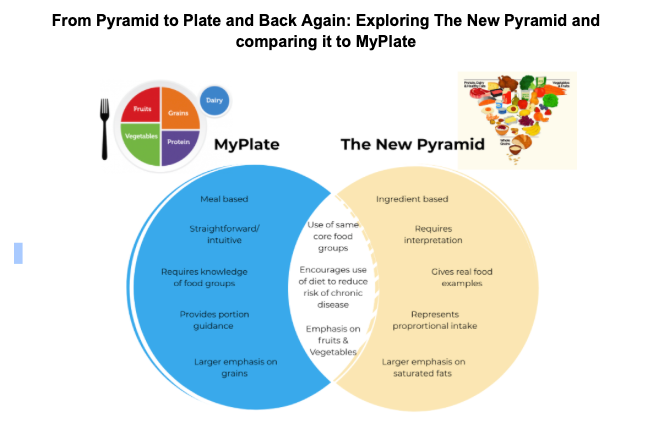
Every five years, the Dietary Guidelines for Americans are updated to reflect the latest nutrition science. The most recent update, released January 7, 2026, introduces a major visual shift: MyPlate is being retired and replaced with a newly redesigned food pyramid.
Since 2011, MyPlate has served as a simple, practical guide to building balanced meals and for many of us, it replaced the classic food pyramid we grew up with. So what’s changed, and what does it mean for everyday eating?
What Changed Visually?
The plate is gone.
MyPlate was widely embraced because it showed, at a glance, how to build a balanced meal. Its plate format was:
Easy to understand
Practical for daily use
Adaptable across cultures, since it focused on food groups rather than specific foods
The New Pyramid takes a different approach.
Instead of showing a full meal, the updated pyramid:
Emphasizes ingredients rather than meals
Includes visual food examples
Requires more interpretation from the reader when planning meals
While informative, this shift makes it less intuitive for building meals.
What Stayed the Same?
Despite the visual redesign, much of the nutritional foundation remains unchanged:
The core food groups are still emphasized: fruits, vegetables, grains, protein, and dairy
Fruits and vegetables continue to make up about half of the visual model

What’s New?
There are a few notable shifts in emphasis:
Protein plays a larger roleProtein now makes up roughly one-third of the pyramid, compared to one-quarter in MyPlate.
Grains take up less spacePreviously equal to protein, grains now play a smaller visual role.
Fats are more visible
Healthy fats like olive oil, fish, and nuts are highlighted for their omega-3 and omega-6 benefits.
Saturated fats (such as butter, red meat, and cheese) are also included. It is important to note the need for moderation with these foods due to their impact on cholesterol and heart health when consumed in excess.
What Does This Mean for Everyday Eating?
Using the New Pyramid requires:
More thoughtful food choices within each group
Greater attention to portion sizes
By contrast, MyPlate continues to offer a clear, approachable way to build balanced meals, especially when working with diverse populations and cultural cuisines.
That’s why many organizations, including Nutrition Education For All, will continue to use the plate-building method when working with clients. It remains a simple, flexible, and effective tool for translating nutrition science into real-life eating habits.
The Bottom Line
At the end of the day, both MyPlate and the New Pyramid share the same goal: supporting long-term health and reducing the risk of chronic disease.
When paired with regular physical activity, a diet rich in fruits, vegetables, whole grains, healthy fats, and quality proteins can make a meaningful difference in how we feel both day-to-day and over time.
Nutrition guidance may evolve, but science remains the foundation. And at Nutrition Education For All, we’ll continue using tools that help people feel confident, empowered, and supported in making informed food choices.
Written by Julia Langer for Nutrition Education For All


Comments